
Eighteen months after hanging up his professional skis following a decorated career in cross-country skiing, Pål Golberg has signaled a formidable second act as an endurance runner. The 35-year-old Norwegian, a former Olympic and World Championship medalist, delivered a career-defining performance at the Frankfurt Marathon this past Sunday, clocking a blistering time of 2:18:55. This achievement places him among the elite ranks of Norwegian long-distance runners and confirms that his cardiovascular engine, honed over 16 years of World Cup competition, remains world-class.
A Masterclass in Frankfurt
The Frankfurt Marathon, widely recognized as one of the fastest courses in Europe, provided the ideal stage for Golberg’s latest breakthrough. Finishing 19th overall in a highly competitive international field, Golberg’s time of 2:18:55 is not merely a personal milestone; it is an entry into the upper echelon of the current Norwegian distance running hierarchy.

While the race was won by Ethiopia’s Jirata Lelisa Denki in a stellar 2:05:25, the focus of the Nordic sports community shifted to the former skier who, until very recently, was navigating snow-covered tracks rather than asphalt. The transition from the high-intensity, explosive, yet stamina-heavy demands of cross-country skiing to the rhythmic, high-impact discipline of road racing is notoriously difficult. Many elite athletes struggle with the biomechanical differences; however, Golberg appears to have made the adjustment with relative ease.
From Nordic Glory to Road Running Success
To understand the magnitude of this achievement, one must look at Golberg’s trajectory over the past year. Following his retirement in April of last year—marking the end of an era that spanned 227 World Cup starts and 19 individual victories—he began a methodical shift toward long-distance running.
His debut at the Oslo Marathon last year resulted in a commendable fifth-place finish with a time of 2:28:11. That performance served as a baseline, demonstrating potential. By June, he had refined his training, securing a victory at the prestigious Nordmarka Skogsmaraton. The jump from 2:28:11 to 2:18:55 in roughly one year represents a significant improvement in aerobic efficiency and lactate threshold management—attributes he clearly carried over from his professional skiing days.
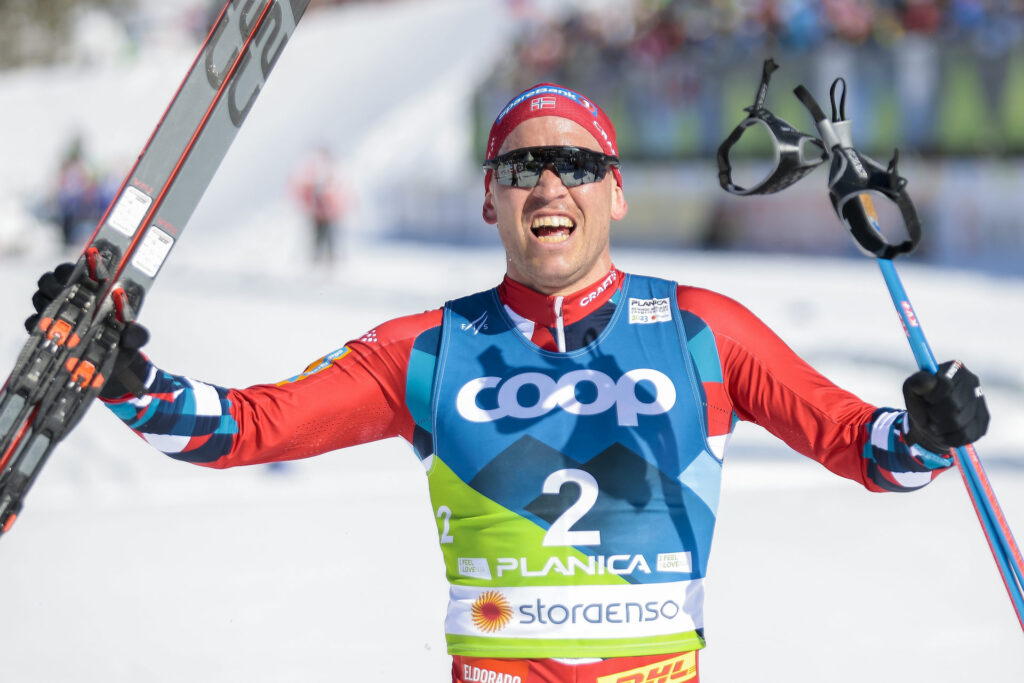
A Career Defined by Consistency
Pål Golberg’s sporting pedigree is unquestionable. During his 16-year tenure on the world stage, he became synonymous with versatility and resilience. His résumé includes participation in two Olympic Games (2014, 2022) and four World Championships (2013, 2021, 2023, 2025).
Perhaps his crowning achievement was his individual gold medal in the 50-kilometer event at the 2023 World Championships in Planica. This race, arguably the most grueling in the sport, highlighted his ability to maintain a high output over several hours, a skill that has clearly translated to the 42.195-kilometer distance of a marathon. With one Olympic silver medal from the 2022 relay and a collection of 56 podium finishes throughout his career, Golberg enters the running world not as a novice, but as a seasoned athlete who understands the physiological demands of elite-level competition.
Peer Recognition and Industry Reaction
The sporting community has been quick to recognize the gravity of his performance. Petter Skinstad, a prominent Norwegian skiing analyst, took to social media to express his admiration, stating, "I bow my head in respect," a sentiment echoed by several other figures in the Nordic endurance landscape.
The broader implications of this transition are being watched closely by athletic federations. The success of former skiers in running is becoming a notable trend. The physiological crossover—specifically the high VO2 max and mental fortitude required for skiing—provides a distinct advantage for those transitioning to the marathon.
The Broader "Running Boom" Among Skiers
Golberg is not an outlier, but rather part of a growing movement of Scandinavian winter athletes who are finding success on the road. The most prominent example is Therese Johaug, the legendary cross-country skier, who has recently posted times that have sparked serious discussions regarding a potential qualification for the 2028 Olympic Marathon in Los Angeles.
This trend is prompting closer collaboration between the Norwegian Ski Federation and the Norwegian Athletics Federation. The cross-pollination of coaching strategies, recovery protocols, and nutritional plans is allowing these athletes to bypass the traditional learning curve. For the Athletics Federation, the influx of high-caliber aerobic athletes like Golberg and Johaug represents a potential goldmine of talent for national relay teams and long-distance representation.

Analysis: Can a Skier Become an Elite Marathoner?
The physiological profile of a cross-country skier is remarkably similar to that of a marathon runner, but the mechanical load is different. Skiing is a full-body sport, distributing strain across the upper body, core, and legs. Marathon running, conversely, places extreme repetitive stress on the lower kinetic chain—specifically the calves, hamstrings, and feet.
Golberg’s success suggests he has managed to strengthen his structural resilience against the repetitive impact of running. Analysis of his race splits in Frankfurt indicates that he maintained a remarkably consistent pace, avoiding the "wall" that often plagues amateur runners who transition to the marathon distance. His ability to maintain a sub-3:20 minute-per-kilometer pace over the final stages of the race is a testament to his refined aerobic engine and the high-intensity training cycles he maintained throughout his skiing career.
Future Outlook and Strategic Implications
As Golberg looks toward his future in the sport, the question arises: how far can he go? While he has stated that he is enjoying the challenge, he has not yet announced a full-time commitment to the professional circuit. However, his current trajectory puts him in contention for top-tier regional events and perhaps even a spot on the national team for international road racing events.

The implications for the sport of running in Norway are significant. The visibility that athletes like Golberg bring to the marathon distance is likely to drive further interest and investment in the sport. Furthermore, his performance serves as a case study for sports science departments examining the longevity of elite endurance athletes.
Chronology of Pål Golberg’s Athletic Milestones
- March 2010: World Cup debut at the Drammen city sprint.
- 2013: First World Championship appearance in Val di Fiemme; wins national gold in sprint.
- 2014: Olympic debut in Sochi.
- 2020: National champion in the 30-kilometer event.
- 2022: Olympic silver in the relay; concludes high-level international skiing career.
- September 2023: Marathon debut at Oslo, finishing in 2:28:11.
- June 2024: Victory at the Nordmarka Skogsmaraton.
- October 2026: Career-best 2:18:55 at the Frankfurt Marathon, marking his entry into the top 10 historical performances for his age cohort in Norway.
Conclusion
Pål Golberg’s transition is a compelling narrative of athletic evolution. He has successfully pivoted from a discipline defined by snow, wax, and technical precision to one defined by grit, cadence, and pavement. His performance in Frankfurt is not just a personal achievement; it is a clear indicator that the endurance base built over decades in the cross-country skiing World Cup is arguably the best foundation for a career in marathon running.
As he continues to integrate into the world of distance running, the sports world will be watching to see if his 2:18:55 is merely a waypoint on a longer journey toward even faster times. For now, Golberg stands as a beacon of what is possible when a world-class athlete applies their discipline to a new challenge, effectively bridging the gap between two of the most demanding sports in existence. His journey underscores the reality that while the medium may change—from skis to shoes—the drive for excellence remains constant.

