
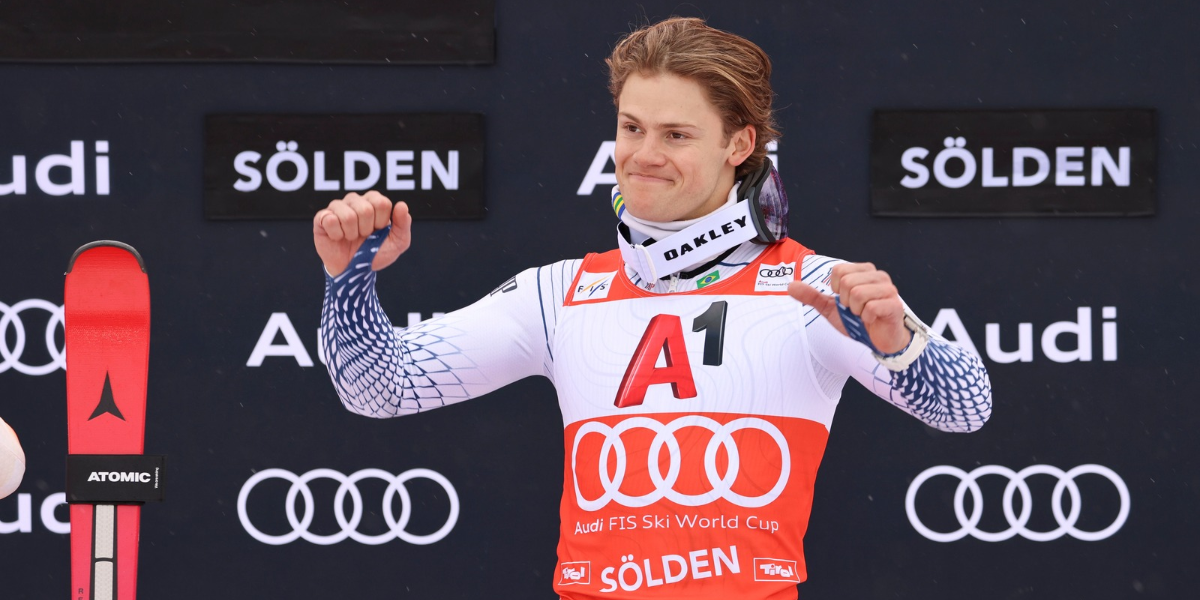
The 2026-27 FIS Alpine Ski World Cup season opened with a statement of intent on the Rettenbach glacier in Sölden, Austria, where Brazilian Olympic champion Lucas Pinheiro Braathen claimed a commanding giant slalom victory. While the win itself—a 0.48-second margin over Switzerland’s Loïc Meillard—was a clinical display of technical mastery, the aftermath revealed a shift in the athlete’s internal compass. Having secured the two most prestigious titles in the sport—Olympic gold and the giant slalom Crystal Globe—the 26-year-old is now navigating the complex psychological terrain that follows the fulfillment of a lifelong ambition. For Pinheiro Braathen, the current season is not merely about accumulating more hardware; it is an exploration of whether his greatest competitive potential lies in his ability to detach from the pressure of results and lean into the process of mastery.
The Sölden victory serves as a bookend to a remarkable trajectory that began when the skier stepped away from the professional circuit in 2023, only to return under the flag of his mother’s homeland, Brazil. His comeback was not merely a return to form but a complete recalibration of his identity as a competitor. By securing an Olympic title and a season-long discipline globe in 2026, he validated a decision that many at the time viewed as a professional risk. Now, as the sport shifts toward the technical demands of the new season, Pinheiro Braathen is signaling that his "first chapter" of redemption has concluded, and he is entering a phase defined by curiosity and autonomy.
A Chronology of a Relentless Rise
The path to the Sölden podium was paved with significant logistical and personal hurdles. Following his high-profile exit from the Norwegian team in 2023, Pinheiro Braathen spent months in a professional limbo that would have derailed most athletes. His transition to the Brazilian team was finalized in time for the 2024-25 season, marking the beginning of a rapid climb up the FIS points list.
By the 2025-26 season, he had established himself as a dominant force in the giant slalom. The highlight of that campaign—his Olympic gold medal performance—marked the first time a South American athlete had reached the pinnacle of Winter Olympic skiing. This achievement effectively shifted the competitive landscape, proving that a boutique, independent team structure could dismantle the traditional, resource-heavy national team models that have historically dominated alpine skiing.
The Sölden race on October 25, 2026, was a test of whether he could maintain this momentum. Despite adverse weather conditions that forced a shortening of the Rettenbach course, Pinheiro Braathen navigated the variable, choppy snow with an ease that suggested a mastery of terrain rather than just speed. His first run set the pace, and his second run, performed under immense pressure from established stars like Marco Odermatt, cemented his status as the man to beat.
Data-Driven Ambition and the Shift to Super-G
While his success in technical disciplines is well-documented, the most significant development in Pinheiro Braathen’s strategy for the 2026-27 season is his planned expansion into the speed disciplines, specifically the Super-G. Statistically, the overall World Cup title—the most coveted prize in skiing—is almost exclusively the domain of "all-rounders."
For the past five seasons, Marco Odermatt has dominated the overall standings by consistently scoring high-point totals in giant slalom, Super-G, and occasionally downhill. Pinheiro Braathen’s current strategy is a direct challenge to this paradigm. By integrating Super-G into his schedule, starting with upcoming races in Colorado, he is not just hunting for points; he is seeking to bridge the gap in his profile that previously prevented him from mounting a serious season-long challenge for the overall globe.
Analysis of his performance metrics shows that while his slalom and giant slalom times are elite, his overall ranking was hampered last year by his absence from speed events. If he can secure top-ten finishes in the Super-G, he will mathematically neutralize the advantage currently held by speed-focused specialists. This is a calculated risk; shifting from the technical finesse of slalom to the high-velocity, high-risk environment of Super-G requires a significant change in equipment, training volume, and physical conditioning.
The Ecosystem Model: Redefining Team Dynamics
Beyond the technical shifts, the most profound change in Pinheiro Braathen’s career is the structure of his support system. In an industry where hierarchical coaching staffs are the norm, Pinheiro Braathen describes his team as an "ecosystem" or "circle." This flat-structure approach minimizes internal friction and allows for rapid decision-making, which he credits as a key component of his mental stability.
Industry insiders note that this structure is becoming a blueprint for other independent athletes. By removing the bureaucratic layers of national federations, Pinheiro Braathen has created a environment where the focus remains exclusively on performance and mental well-being. "We don’t operate with hierarchy," he stated during the post-race press conference in Sölden. "We are a family, and every decision is a collaboration." This sentiment is reflected in his performances; he often appears more relaxed on the course than his peers, a byproduct of a team culture that prioritizes long-term athlete health over short-term political pressures.
Broader Implications for South American Winter Sports
The influence of Pinheiro Braathen’s success extends far beyond his individual record. His presence on the podium has sparked a resurgence in interest for winter sports in Brazil, a nation with no tradition of alpine skiing. By acting as a trailblazer, he is forcing a global conversation about accessibility in a sport that is traditionally reserved for athletes from a handful of European and North American countries.

Sports sociologists and industry analysts observe that his success creates a "democratization effect." When an athlete from a non-traditional nation captures an Olympic gold, it triggers increased funding, sponsorship interest, and grassroots development in that region. Pinheiro Braathen’s conscious effort to represent Brazil—a decision that was initially met with skepticism—has now become a source of national pride and a catalyst for change. He has explicitly stated that his goal is to "bring change" and prove that there is more than one path to the top. By showing that an individual can succeed outside of the established "big-team" pipelines, he is empowering a new generation of athletes to pursue unconventional routes to professional competition.
The Path Forward: Balancing Ambition and Enjoyment
As the World Cup circuit moves toward the upcoming slalom and speed events, the question remains whether Pinheiro Braathen can maintain this equilibrium. He has been clear about his desire to win an overall globe, yet he emphasizes that this ambition is no longer a source of anxiety. He views the season as a marathon, noting that the overall title is "never won in one day."
His approach to the next few weeks is characterized by a disciplined, almost clinical preparation, coupled with a deliberate effort to avoid burnout. After his victory in Sölden, he pointedly prioritized celebration and social connection with his team before shifting his focus to the "slalom project." This ability to switch off is perhaps his most potent weapon. While his rivals may be over-analyzing every hundredth of a second in the wake of the season opener, Pinheiro Braathen is focused on the long-term sustainability of his performance.
The 2026-27 season will likely be defined by the rivalry between the established dominance of Odermatt and the evolving, versatile challenge posed by Pinheiro Braathen. However, the Brazilian’s true victory may not be the trophies he accumulates by March, but the fact that he has achieved a level of professional autonomy that few in the history of the sport have ever attained. By decoupling his sense of self-worth from the stopwatch, he has paradoxically become a more dangerous, more consistent, and more formidable competitor.
Whether he successfully captures the overall globe or simply redefines what it means to be an elite skier, Pinheiro Braathen’s journey serves as a case study in the power of psychological liberation. He is no longer just racing against the best in the world; he is racing to see how far he can push the boundaries of his own potential in an environment of his own creation. As the circuit heads to Colorado and beyond, the eyes of the alpine world will be fixed on the Brazilian, not just to see if he wins, but to observe how this newfound freedom manifests in the high-stakes environment of international competition.

