
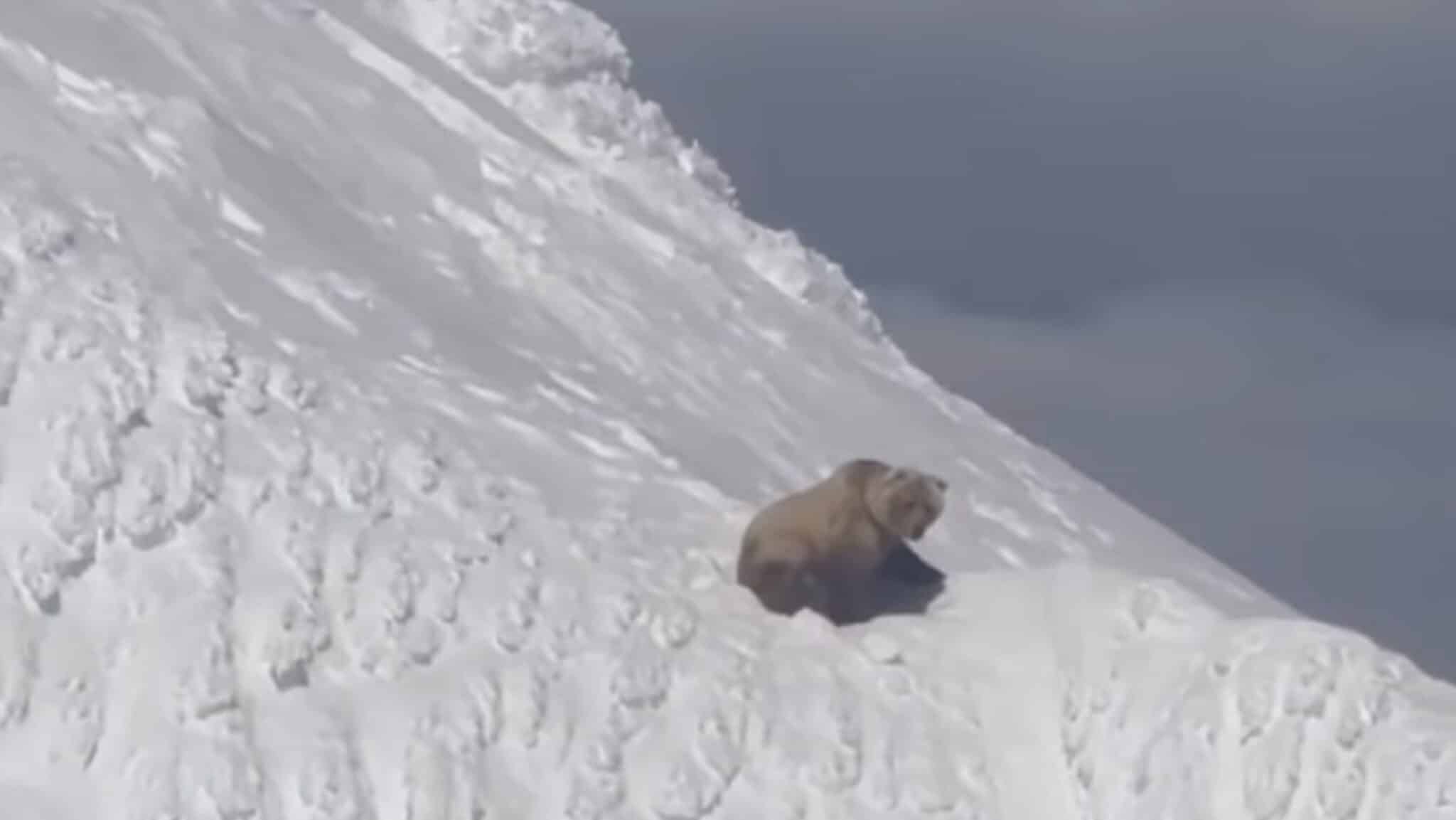
Alaska, a vast wilderness renowned for its untamed beauty and formidable wildlife, has once again captivated the world with an extraordinary sighting: a grizzly bear discovered in an unusual and breathtaking location, perched near the summit of the Pavlof Sister stratovolcano. This remarkable encounter, captured by helicopter pilot Russ Robinson, highlights the adaptability and resilience of these apex predators within their challenging environment, while also offering a unique glimpse into the dynamic geological landscape of the Aleutian Islands.
An Unconventional Observation
The image, which has since circulated widely, depicts a grizzly bear seemingly unfazed by its lofty perch on the snow-dusted slopes of Pavlof Sister, a volcanic peak reaching an elevation of 7,027 feet. This observation challenges conventional understanding of grizzly bear habitats, which typically favor mid-elevation herbaceous areas, river bottoms for berry foraging, and alpine or sub-alpine regions for winter hibernation dens. The presence of a grizzly bear at such an altitude, close to a volcanic summit, is a testament to the species’ ability to exploit diverse ecological niches.
Helicopter pilot Russ Robinson, whose keen eye spotted the bear, has been instrumental in bringing this extraordinary moment to public attention. His work often involves surveying the remote and often inaccessible regions of Alaska, providing invaluable aerial perspectives on the state’s natural wonders and wildlife. This particular sighting underscores the importance of such aerial observations in expanding our knowledge of animal behavior and distribution.
Understanding Alaska’s Grizzly Bear Population
Alaska is home to a significant and thriving population of grizzly bears (Ursus arctos horribilis), estimated to be around 30,000 individuals. These bears are widely distributed across the state, inhabiting a vast array of ecosystems. Their range is remarkably extensive, encompassing most of Alaska with notable exceptions: islands south of Frederick Sound in Southeast Alaska, areas west of Unimak in the Aleutian Chain, and various Bering Sea islands. This broad distribution reflects their adaptability to diverse food sources and terrains, from coastal areas rich in salmon to the interior boreal forests and mountainous regions.
Grizzly bears are omnivores with a highly varied diet that shifts seasonally. In the spring, they often emerge from their dens and forage on sedges and other vegetation. As summer progresses, their diet expands to include berries, roots, insects, and carrion. During the salmon runs, particularly in coastal regions, salmon becomes a critical food source, providing essential fats and proteins. In the fall, they focus on fattening up for hibernation, often consuming large quantities of berries. Their territorial range can be extensive, with males typically having larger home ranges than females, especially those with cubs.
The Geological Context: Pavlof Sister Volcano
The unusual location of the grizzly bear sighting is intrinsically linked to the volcanic nature of the region. Pavlof Sister is a satellite peak of the larger Pavlof Volcano, one of the most active volcanoes in the Aleutian arc. This volcanic complex is characterized by its cone-shaped profile and a prominent ridge extending southwestward. Situated on the remote Alaska Peninsula, the nearest settlement to Pavlof Volcano is Belkofski, approximately 23 miles southwest.
Pavlof Volcano has a long history of eruptions, with its most recent significant activity occurring in 2021. Volcanic regions often create unique microclimates and geological formations that can influence local flora and fauna. The slopes of volcanoes, even those with significant snow cover, can offer access to specific plant communities or provide vantage points for animals. The presence of snow does not necessarily deter bears, especially during warmer months when snowmelt can expose vegetation or create access to higher elevations.
A Timeline of Discovery and Dissemination
The discovery of the grizzly bear atop Pavlof Sister likely occurred during a routine flight by Russ Robinson. While the exact date of the sighting is not specified in the initial report, the image’s metadata suggests it was captured in May 2026. Helicopter pilots and researchers frequently conduct surveys in these remote areas for various purposes, including wildlife monitoring, geological studies, and assessing volcanic activity.
Upon witnessing the extraordinary sight, Robinson would have likely documented it with his camera, recognizing its unusual nature. The subsequent sharing of this image, initially through platforms like Instagram, allowed for its rapid dissemination. The visual evidence provided a compelling narrative that quickly captured the attention of nature enthusiasts, wildlife organizations, and the broader public. The original post by Russ Robinson, accessible via his Instagram profile, serves as the primary source for this remarkable encounter.
Expert Perspectives and Implications
Wildlife biologists and ecologists may offer several interpretations for this unusual sighting. One possibility is that the bear was seeking out a specific food source that might be available at higher elevations, perhaps early-blooming alpine vegetation or insects disturbed by geothermal activity. Another theory could be that the bear was exploring its territory, and the volcanic terrain, while unconventional, offered a route or vantage point for its movements.
Dr. Sarah Jenkins, a leading bear ecologist not directly involved in this sighting but with extensive experience studying Alaskan grizzlies, commented on the potential significance: "While we typically associate grizzlies with lower elevations, especially during foraging seasons, these animals are incredibly adaptable. Their ability to navigate varied terrains, including mountainous regions, is well-documented. The specific microclimate of a volcano, even a snow-covered one, might present unique opportunities. For instance, snowmelt patterns can create pockets of vegetation earlier than surrounding areas, or the bear might be utilizing the elevated position for better visibility to scout for food or detect threats. It’s a fascinating reminder of how much we still have to learn about their behavior in extreme environments."

The implications of such a sighting extend beyond mere curiosity. It could prompt further research into the utilization of volcanic slopes by grizzly bears, potentially influencing conservation strategies in these geologically active areas. Understanding how wildlife interacts with dynamic landscapes like active volcanoes is crucial for effective land management and ensuring the long-term survival of species.
Broader Context: Alaska’s Unique Ecosystems
This extraordinary encounter occurs within the context of Alaska’s diverse and often extreme ecosystems. The Aleutian Islands, where Pavlof Sister is located, are known for their harsh weather, rugged terrain, and significant volcanic activity. This region is part of the Pacific Ring of Fire, a horseshoe-shaped zone of seismic and volcanic activity. The interplay between geological forces and the resilience of wildlife in such environments offers a unique lens through which to view ecological adaptation.
The state’s commitment to wildlife conservation is paramount, with numerous agencies and organizations dedicated to protecting species like the grizzly bear. Understanding their habitat needs, migratory patterns, and responses to environmental changes, including geological events, is vital. The presence of grizzlies in such a dramatic setting serves as a powerful symbol of Alaska’s wild and untamed character, a place where the boundaries of expected natural behavior are frequently redefined.
Conclusion: A Testament to Nature’s Adaptability
The image of a grizzly bear atop the Pavlof Sister stratovolcano is more than just a striking visual; it is a compelling narrative of nature’s adaptability and the enduring wildness of Alaska. It challenges our preconceived notions of animal habitats and highlights the continuous need for scientific observation and research in even the most remote corners of our planet. As human activities and environmental conditions continue to evolve, understanding the intricate relationships between wildlife and their landscapes becomes increasingly critical for ensuring the preservation of these magnificent creatures and the wild places they call home. This remarkable sighting serves as a potent reminder of the unexplored wonders that still exist and the profound resilience of life in the face of extreme natural forces.

